
For families who are doing everything right at the grocery store and still losing ground
The Kitchen Skills That Kept American Families Fed for Generations Got Lost in About Fifty Years. An Off-Grid Amish Man Just Wrote Them Back Down.
Butter that keeps on a pantry shelf. A root cellar built from a barrel. A smokehouse, a clean water supply and a pantry that runs on what you put up, not on whatever the store is charging this week.
Dear Friend,
One family kept the receipts. Same store, same list, the same ordinary basket of staples they had been buying for years.
In 2019 that basket came to $273.46.
The last time they bought it, the register said $386.77.
Nothing about the food changed. Nobody in that house started eating more. The only thing that moved was the price, and it only ever moved one way.
If you have felt that in your own kitchen, you already know the strange part.
You have probably done everything you were told to do.
You clip the coupons. You buy in bulk. You switched to the store brand years ago. Maybe you started baking your own bread to save a few dollars, and you are proud of it, and you should be.
And the bill still climbs.
One mother put it about as plainly as anyone can. Her family's food bill was around $650 to $700 a month in 2019. Today it runs closer to $850 to $1,000, and that is with her trying every possible way to buy things cheaper, and milling her own wheat berries for bread.
She is not doing anything wrong. Neither are you.
Why being frugal can never win this fight
Every money-saving trick you have ever tried has one thing in common. Coupons, bulk runs, store brands and sales all help you buy more cheaply.
But you are still buying.
Every jar of beans, every pound of butter and every bag of flour in your kitchen was paid for at this week's price. So when this week's price goes up, your bill goes up with it, no matter how clever you are about it. Frugality slows the leak. It cannot close it.
There is only one lever that actually stops the climb, and our great-grandparents pulled it every single summer: they produced and put up a big share of what the rest of us now buy.
They did not think of it as a money strategy. It was simply how a household ran.
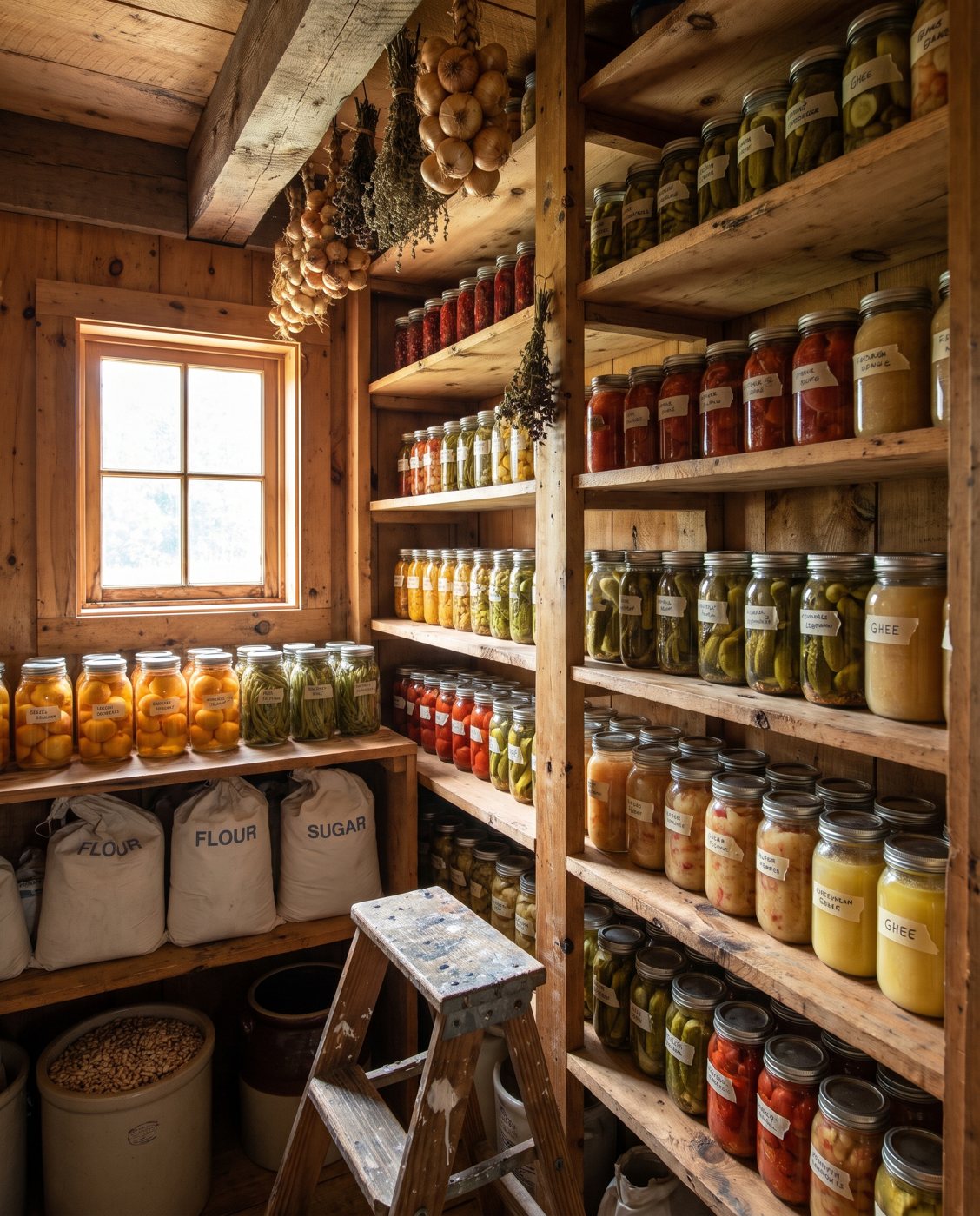
The garden came in, and it went into jars. Butter got clarified so it would keep on a shelf. Meat got cured, dried or smoked. Potatoes, apples and roots went down into the cellar. By the first frost, a family's winter was sitting in the pantry, already paid for, and the price at the store in February didn't matter much to them.
So where did all of that knowledge go?
It did not disappear because it stopped working. It disappeared because, for a few decades, it looked like nobody needed it.
Food got cheap. Supermarkets got big. The refrigerator, the freezer and the weekly shopping trip took over the jobs the pantry and the cellar used to do. Grandma still knew how to put up forty quarts of beans, but her daughter was busy, the store was right there, and nobody wrote it down.
That is how skills get lost. Nobody throws them away. They just skip a generation, and then a second one, and then there is no one left in the family to ask.
Because there is one group of American families who never stopped.
The families who kept doing it the old way, every day, on purpose
Amish households never handed their kitchens over to the supermarket. Many of them live without the conveniences the rest of us depend on, so the old skills were never optional for them. They had to keep working, so they kept getting passed down, mother to daughter and father to son, the same way they were in your great-grandparents' house.
Which is why the man who wrote this book matters.
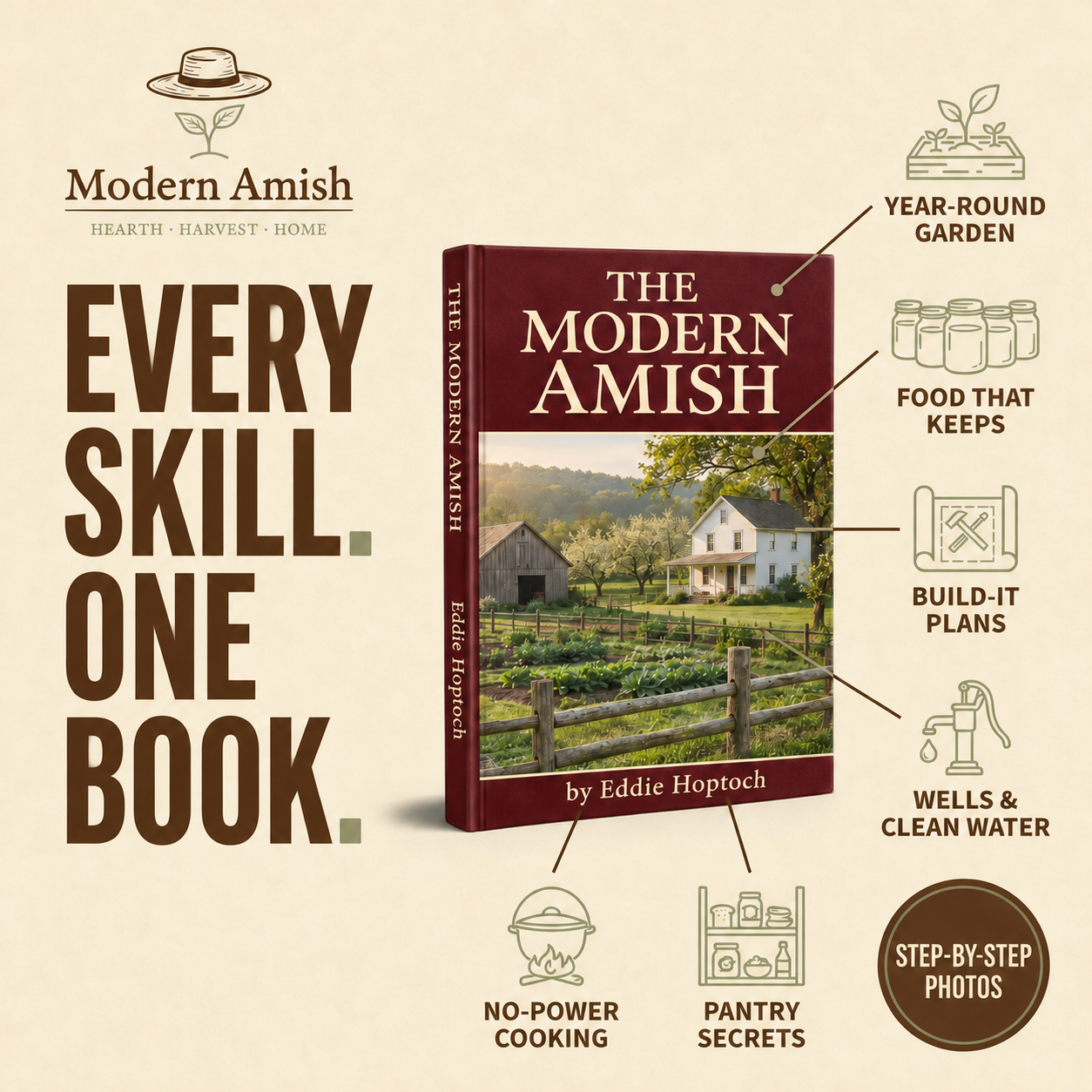
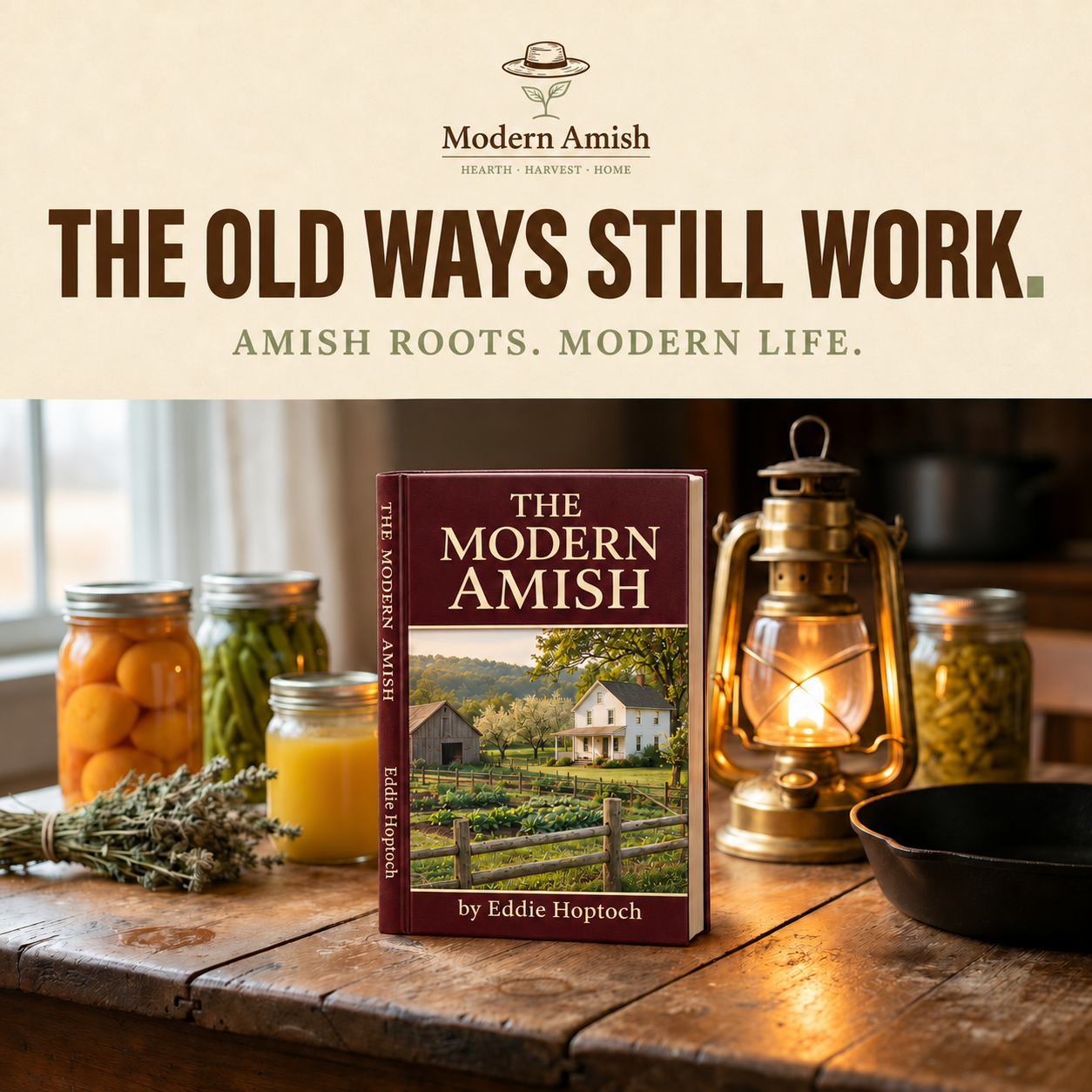
Eddie Hoptoch is part Amish, and he lives off the grid. He is a private person. He doesn't give interviews and you won't find him on YouTube. He wrote this book himself and put it out under his own name to help ordinary families learn what Amish households never stopped doing.
That matters more than it used to, because the bookstore shelves and the internet are now crowded with "Amish" and "homesteading" books put together by people who have never canned a bean in their lives. Some are stitched together from blog posts. Some are written by software. Many of them recycle the same tired list of tips with a bonnet on the cover.
The Modern Amish is the opposite of that. It was written by a man who lives this way, and who kept only the practices that still earn their place in a modern home.
That last part is important, so here it is in Eddie's own spirit: keep what still works, and drop what nobody misses. Nobody misses hauling water by hand. But a pantry that feeds your family through the winter? A jar of butter that keeps on the shelf? A salve you can make on your own stove, like the ones at the Amish market stand? Those are worth keeping, and those are what this book is about.
Here is what's waiting for you inside
The Modern Amish is laid out the way a household actually runs: grow it, put it up, store it, then cook it. Every project lists the materials and tools you need, then walks you through it with a full-color photo for each step, so you can see what it is supposed to look like before you try it.
The Year-Round Garden
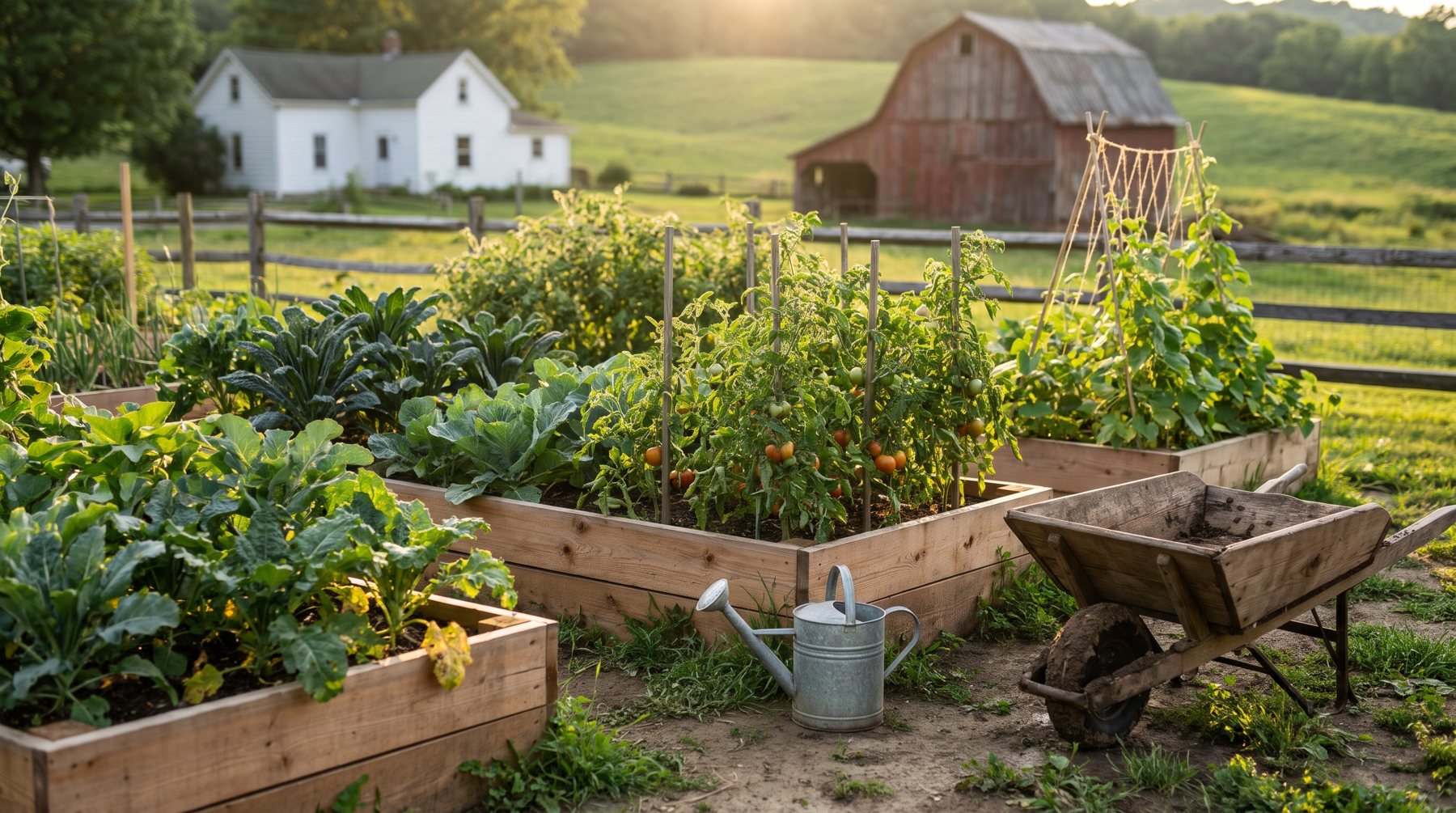
- How to plan a garden that keeps producing across the seasons, so you aren't drowning in zucchini in August and buying everything in March.
- Building raised beds, step by step, with the materials list laid out before you start.
- How to grow more food in less space, which is the whole game on an ordinary suburban lot.
Preserving the Harvest
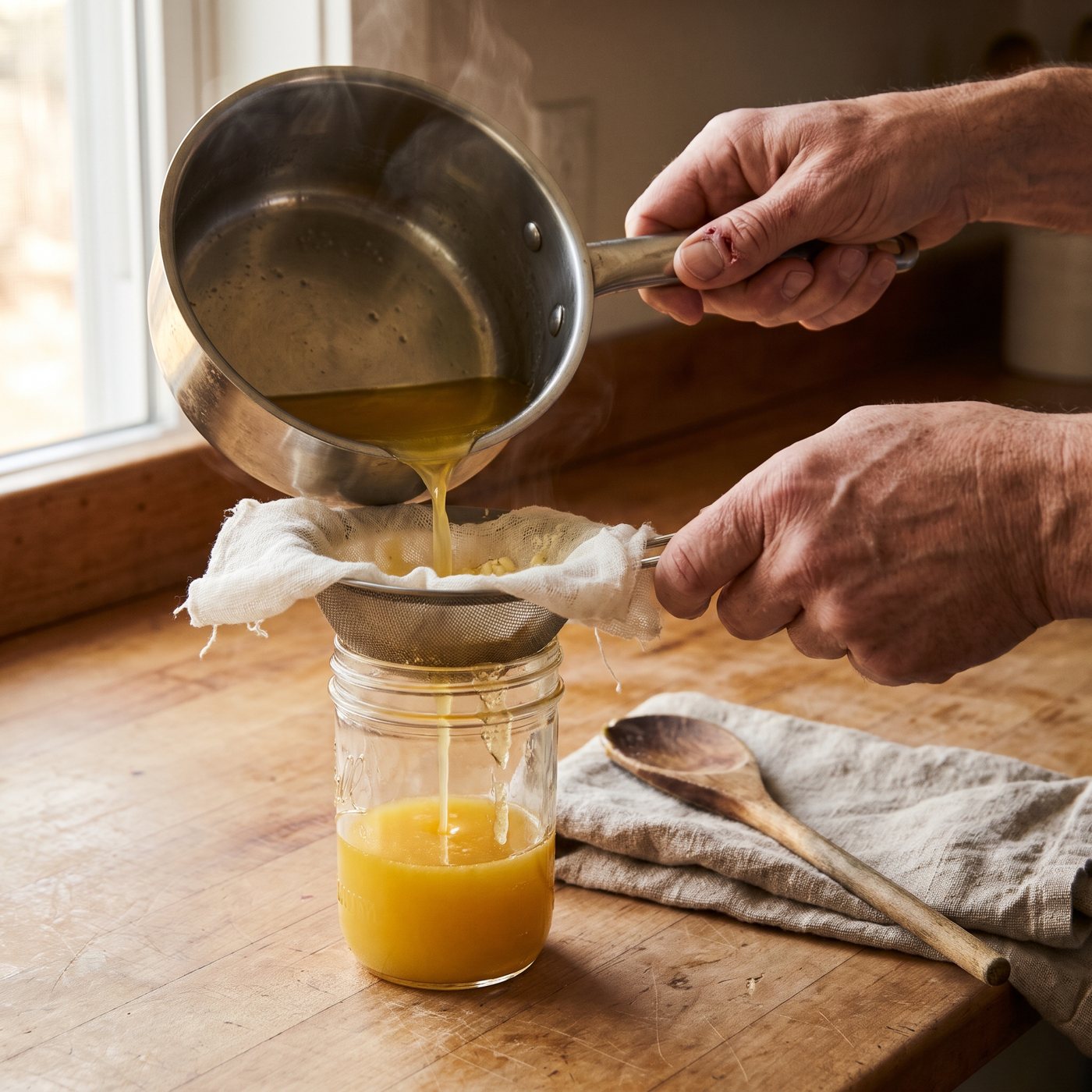
- "Forever butter": how Amish kitchens turn ordinary butter into a golden, clarified butter that keeps on the pantry shelf.
- Canning beans and the other everyday staples you buy most often, so they come off your own shelf instead of the store's.
- Curing meat and making dried beef, the old way, the kind your grandmother may have kept in the cupboard.
The Pantry & Root Cellar
- How to turn a spare closet or an empty corner into long-term food storage, no remodel required.
- The barrel root cellar: a cold-storage cellar you build from a barrel, for potatoes, apples and roots.
- The rotation system that keeps flour and dried goods fresh, so nothing in the back of the pantry quietly goes to waste.
Smokehouse & Cold Storage
- How to build a smokehouse for long-keeping meats. (Fair warning: this one needs a yard.)
- How Amish families keep food cold without electricity, which is exactly the kind of knowledge you want before the power goes out, not after.
Wells & Clean Water
- How wells actually work, explained so it finally makes sense.
- How to purify drinking water.
- How to store water properly for emergencies, so a boil notice or an outage is an inconvenience instead of a scramble.
Household Basics
- Making your own candles.
- A simple natural toothpaste made from things you can find easily.
- Other everyday household goods you have been buying for years without ever thinking about how to make them.
Traditional Salves & Remedies
- How to make salves like the ones sold at Amish market stands, on your own stove, with a picture for every step.
- The traditional kitchen-cabinet recipes Amish households have kept for generations.
These are traditional household recipes, shared as craft and tradition. They are not medical advice.
From-Scratch Amish Recipes
- Home-style Amish recipes built around what you grow, can and store.
- Ideas for actually using your pantry, because a shelf of jars only saves you money if they end up on the table.
"But I don't live on a farm."
You don't need to.
The most common worry about books like this is that they were written for people with eighty acres and ten children to help with the chores. The Modern Amish was written for the house you already live in. Most of the projects work in a kitchen, a spare closet, a garage or a small backyard.
We will be straight with you about the exceptions: the smokehouse needs a yard, and raising livestock needs more room than a typical lot. Everything else you can start right where you are.
And if you have never been "a garden person," or every plant you have touched has died, this is the book that was made for you. The steps are shown, not just described. You will see what the soil, the jar or the finished salve should look like at every stage, so you are never guessing.
A real book you can hold, even though it arrives instantly
The Modern Amish is a digital edition. That means a few good things for you.
- It arrives in minutes. The download link lands in your email right after checkout. There is no waiting on shipping and no package left out in the rain.
- It reads on anything. Phone, tablet, laptop or desktop.
- You can print any page you like. Plenty of readers print the whole thing and keep it in a binder in the kitchen drawer. Then it's there when the power is out, the phone is dead and the Wi-Fi is gone.
- It's a gift you can still give on Christmas Eve. Forward the download, or print it and tuck it into a card.
Who this book is for, and who it isn't
It's for you if...
- You're tired of watching the grocery bill climb no matter what you do.
- You want to learn what your grandparents knew, from someone who still lives it.
- You're a beginner, or you've tried before and it didn't take.
- You want your household to be steadier when prices jump or the power goes out.
- You're looking for a gift that someone will actually use.
It's not for you if...
- You've been canning and putting up a big garden for thirty years. You'll find parts of this familiar.
- You want a magic trick. This is real work, done the honest way, one season at a time.
- You want a book about living like the Amish in every way. This is about the household skills, not the religion.
What all of this is worth
Think about where you would otherwise have to go to learn it.
You could buy a separate book on gardening, another on canning, another on root cellars and another on salves, and still have to piece them together yourself. You could spend months watching YouTube videos that contradict each other. You could learn it the way most people do, by trial and error, paying for every ruined batch and every failed build along the way.
Or you could have it all in one place, in the order a household actually needs it, from a man who does it for real.
The Modern Amish is normally $69.95.
Right now, it's $45.95.
That is less than the difference on a single grocery trip for the family whose basket we started with. It's a one-time payment, it's yours to keep, and it's backed by a guarantee that puts all of the risk on us.
Money-Back
Guarantee
Read it for thirty days.
Download it, read it, try a project or two. If The Modern Amish isn't what you hoped for, send us a message through our Contact page within 30 days of your purchase and we'll refund you in full.
No forms and no hoops. You don't even have to give us a reason.
- All 8 chapters: garden, preserving, pantry and root cellar, smokehouse and cold storage, water, household basics, salves and remedies, and from-scratch recipes
- A full-color photo for every step
- A materials and tools list for every project
- Instant download, readable on any device, printable page by page
- 30-day money-back guarantee
One last thing before you decide
Grocery prices haven't gone back to where they were in 2019. Every week you wait is another week of buying every staple at that week's price.
And winter is the best time there is to start. It is when you plan next year's garden, set up the pantry and build the root cellar, so that by the time things start growing, you are ready to put them up instead of watching another summer go by.
Your great-grandmother didn't learn all of this in a weekend, and you won't either. But you can learn the first piece this week. Make a jar of forever butter this weekend. Next week, clear out a closet for the pantry. By spring you'll have a bed planned and ready to plant.
That is how the skills come back into a family. One jar at a time.
From our kitchen to yours,
Modern Amish
The Modern Amish team, publishers of The Modern Amish by Eddie Hoptoch
P.S. If you skimmed down here, here's the short version. The Modern Amish is a step-by-step guide to the household skills that used to keep American families fed: a year-round garden, canning and preserving, a pantry and barrel root cellar, a smokehouse, keeping food cold without electricity, clean water, candles, salves and from-scratch recipes. It was written by an off-grid, part-Amish man, with a photo for every step. It's $45.95 today instead of $69.95, it arrives instantly, and you have 30 days to read it and get a full refund if it's not for you.
P.P.S. Thinking of someone who grew up on a farm, or who loves this kind of thing? It makes a thoughtful gift that won't end up in a drawer, and because it's digital, it can still arrive on time on Christmas morning.
Questions people ask
Is this good for beginners?
Yes. Every project lists the materials and tools first, then shows a photo for each step. If you've been canning for decades, you'll find parts of it familiar.
Do I need a farm or a lot of land?
No. Most projects work in a home or a small yard. The smokehouse and raising livestock need more room.
How do I get it?
It's a digital download sent to your email right after checkout. You can read it on any device and print it.
Can I give it as a gift?
Yes. You can forward the download, or print it and put it in a card.
What if it isn't for me?
Message us through the Contact page within 30 days of your purchase and we'll refund you in full.
Is this book from the Amish church?
No. Modern Amish is not run by the Amish church. The book was written by Eddie Hoptoch, who is part Amish and lives off the grid.